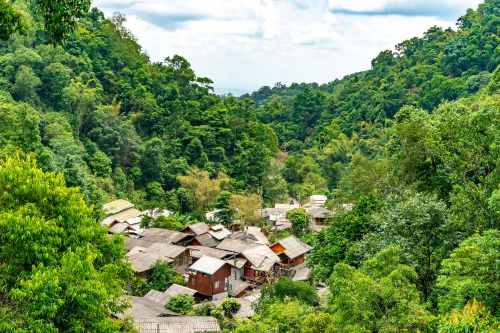
Bo Sang is about nine kilometres east of Chiang Mai’s Old City, close enough to visit in a morning but far enough from the tourist circuit that most visitors who find their way here have made a deliberate choice to do so.
The village has been producing handmade paper umbrellas for centuries, a craft tradition with roots in the broader Lanna cultural heritage of northern Thailand that has, unusually for something this old, remained truly alive. Bo Sang is not a reconstructed heritage experience. The workshops here are working operations, the artisans are producing umbrellas and lacquerware and fans that are sold internationally, and the village has a purpose beyond tourism that gives it a character most craft villages in Southeast Asia have lost.
The Craft Tradition
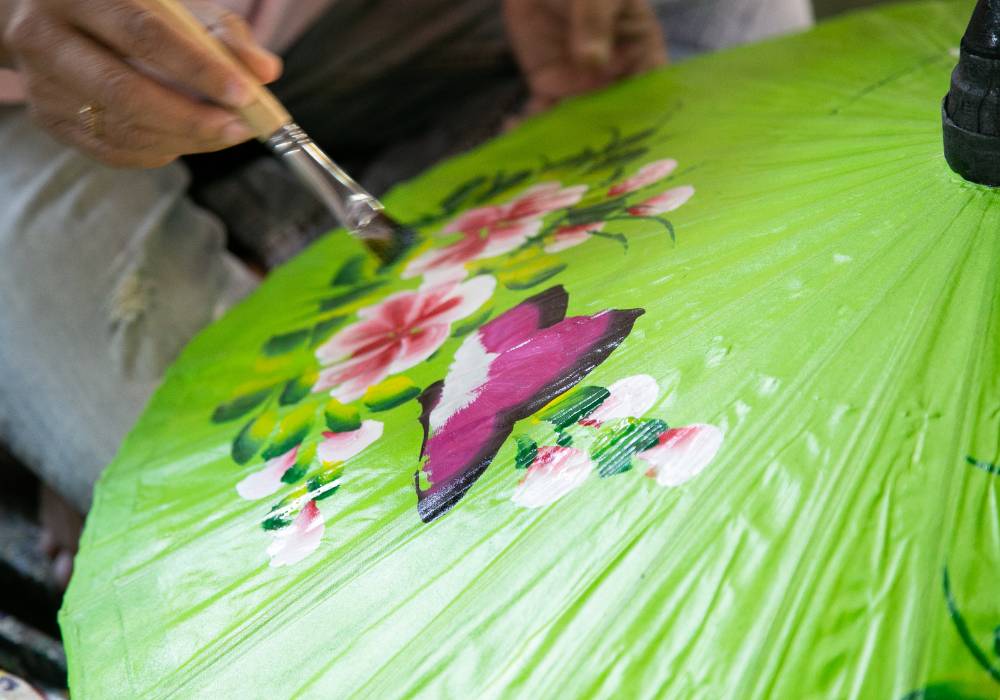
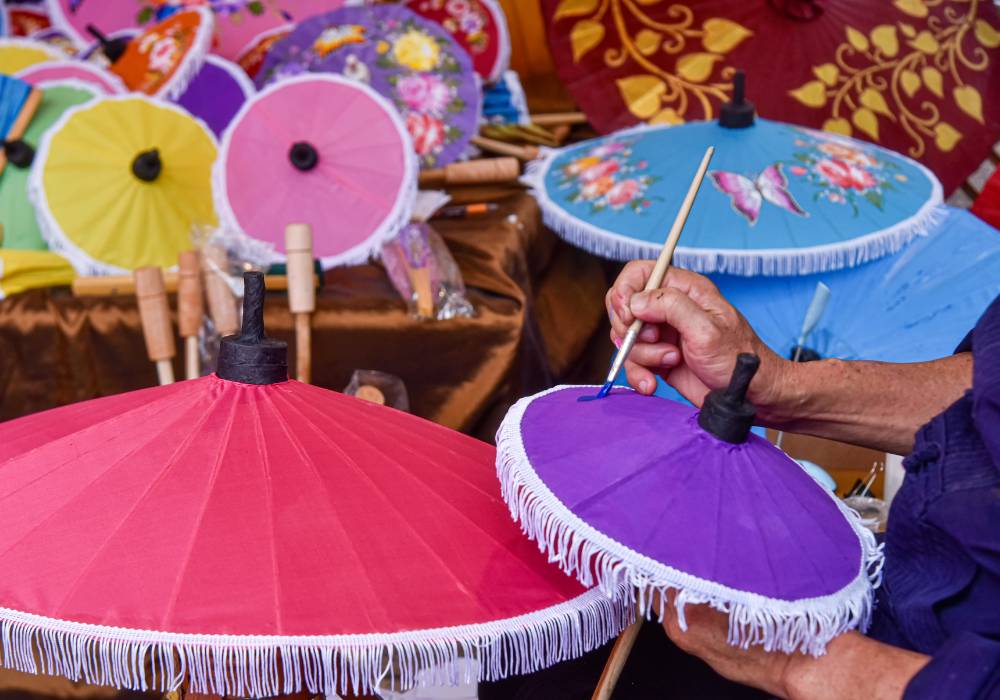
The umbrellas Bo Sang is known for are made from saa paper, a handmade paper produced from the bark of the mulberry tree, stretched over frames of bamboo and lacquered wood. The process is entirely manual and involves a number of distinct stages: splitting and shaping the bamboo ribs, constructing the frame, pressing and drying the paper, attaching it to the frame, and then painting or decorating the surface by hand.
Each stage is typically handled by different members of a family workshop, with skills passed down across generations. What strikes most visitors, and what strikes us every time we bring guests here, is the speed and precision with which experienced artisans work, processes that look impossibly intricate are executed without hesitation, without reference material, and with a consistency that only comes from years of repetition.
The umbrellas range considerably in size and complexity. Small decorative pieces make straightforward gifts. The larger ceremonial umbrellas, some reaching over a metre in diameter, are serious objects, and watching one assembled over the course of a visit gives a much clearer sense of what the craft actually involves than any finished product on a shelf can convey.
Beyond umbrellas, the village also produces painted fans, lacquerware, silverwork, and items decorated with traditional northern Thai motifs. The quality varies between workshops, and part of what we do when we bring guests to Bo Sang is guide them toward the producers whose work and working practices are most worth seeing.
Visiting the Workshops
Bo Sang’s main street is lined with family workshops, most open throughout the day with no entry fee and no booking required. We recommend arriving before 10am — the workshops are at their most active in the morning, the light is good, and the crowds are a fraction of what they become by early afternoon. Our advice is to walk the full length of the street first before settling on any one workshop, as the variation between producers is significant and a quick initial pass makes it much easier to decide where to spend proper time.
Several workshops offer hands-on sessions alongside the standard visits. The most popular with our guests is umbrella painting — working on a plain paper umbrella using traditional decorative motifs under guidance from the artisans. It typically runs between 45 minutes and an hour, and it is one of those activities that sounds like a minor addition to the day and ends up being the part people talk about most afterwards. For guests who want a more in-depth experience covering additional stages of the production process, this is best arranged in advance and we are happy to organise it.
If you are interested in purchasing, the prices at Bo Sang are fair and the quality of the better workshops is high. Bargaining is not generally expected or appropriate here in the way it might be at a night market, these are craftspeople selling their own work, and the pricing reflects the labour involved.
The Bo Sang Umbrella Festival

Bo Sang hosts its annual umbrella festival over three days every January, typically on the third weekend of the month. This is one of the most visually distinctive festivals in northern Thailand and one that we actively recommend building a Chiang Mai itinerary around if the timing allows.
The festival is rooted in the village’s craft identity, it began as a celebration of the umbrella-making tradition and has grown into a broader showcase of Lanna arts and culture without losing sight of what it is actually about. That focus is what separates it from the larger, more generalised festivals on the Thai calendar.
The main street of Bo Sang is transformed for the festival. Every surface is decorated with umbrellas, suspended overhead, arranged in formations along the roadside, attached to vehicles and structures in combinations that make the street look spectacular, particularly in the evening when they are illuminated.
What the festival includes
The centrepiece of the festival is the umbrella parade, held on the Saturday evening. A procession of decorated vehicles, traditionally dressed participants, and illuminated floats moves through the village. The floats are elaborate, months of preparation are involved, and the parade draws considerable crowds, both local and visiting. We recommend arriving early to secure a good viewing position along the route, and we always advise guests to allow more time than they think they need to get there, particularly if travelling from the city centre during the evening.
Alongside the parade, the festival includes a beauty pageant in which participants wear traditional Lanna costume and carry handmade umbrellas, traditional northern Thai music and dance performances, craft demonstrations running throughout the day across multiple workshops simultaneously, and a market running the length of the main street selling local food, crafts, and products from across the Chiang Mai region.
The daytime sessions are a good opportunity to visit workshops that are operating in a more open and demonstrative mode than usual, during the festival, many producers put their full production process on display, and the artisans are generally more accessible and communicative than on a standard day.
Planning around the festival
January is the high season in Chiang Mai. The weather is at its best, dry, clear, and cool by Thai standards, and the city is busy. If you are planning to attend the Bo Sang festival specifically, accommodation in the city should be booked well in advance. The festival itself is free to attend, but the Saturday evening in particular draws large numbers and the surrounding streets can become congested.
We typically recommend combining a festival visit with a broader day in the eastern part of Chiang Mai, the road between the city and Bo Sang passes the Sankampaeng handicraft corridor, a stretch of specialist workshops producing silk, celadon ceramics, lacquerware, and woodwork, many of which are worth a stop. A full day that takes in the craft corridor in the morning, Bo Sang at midday, and the festival parade in the evening is one of the popular day structures we put together for guests during January.
How to get there + our tips
Bo Sang is approximately 15 to 20 minutes from the Old City by road. The most practical way to visit is by private vehicle, which allows you to control your timing and combine the stop with other destinations in the same direction, the Sankampaeng area, the hot springs further east, or Mae Kampong village, which sits further into the mountains along the same general route.
Songthaew (shared red trucks) run along the Sankampaeng Road that passes Bo Sang and are an option for travellers comfortable with the system, but for a workshop visit where timing matters, private transport is the better choice.
The village is quiet on weekday mornings, which is when we prefer to visit outside of festival season. Weekends bring more visitors, more vendors, and a livelier atmosphere, neither is wrong, but they are different experiences and worth factoring into your planning.
There is a small cluster of local food stalls and simple restaurants near the village that serve northern Thai food at lunch. Nothing elaborate, but the food is good and it makes a natural break in the middle of a longer day in the area. We always make a stop here when we are passing through.
Bo Sang is the kind of place that does not demand much of you but rewards attention. The craft tradition here is real, the festival is worth planning around, and the combination of the two, a village that is alive with purpose and a celebration that is rooted in that purpose, makes for a memorable experience. If you are in the city in January, it should be on your itinerary without question. If you are visiting at any other time of year, the workshops alone make the drive worthwhile.
For guests who would like to include Bo Sang as part of a wider day in the Chiang Mai area, or who want to attend the January festival with logistics fully arranged, our team is available to plan accordingly.