Jim Thompson House is one of the cultural landmarks in Bangkok that we regularly recommend to travelers who want to understand Thailand beyond temples and modern shopping centers. Located in the heart of the city near Siam, this historic house museum offers a rare opportunity to experience traditional Thai architecture, Southeast Asian art, and the story of the man who helped revive Thailand’s silk industry. From our experience organizing Bangkok cultural tours, this visit consistently becomes one of the most memorable highlights for our guests.
Who was Jim Thompson?
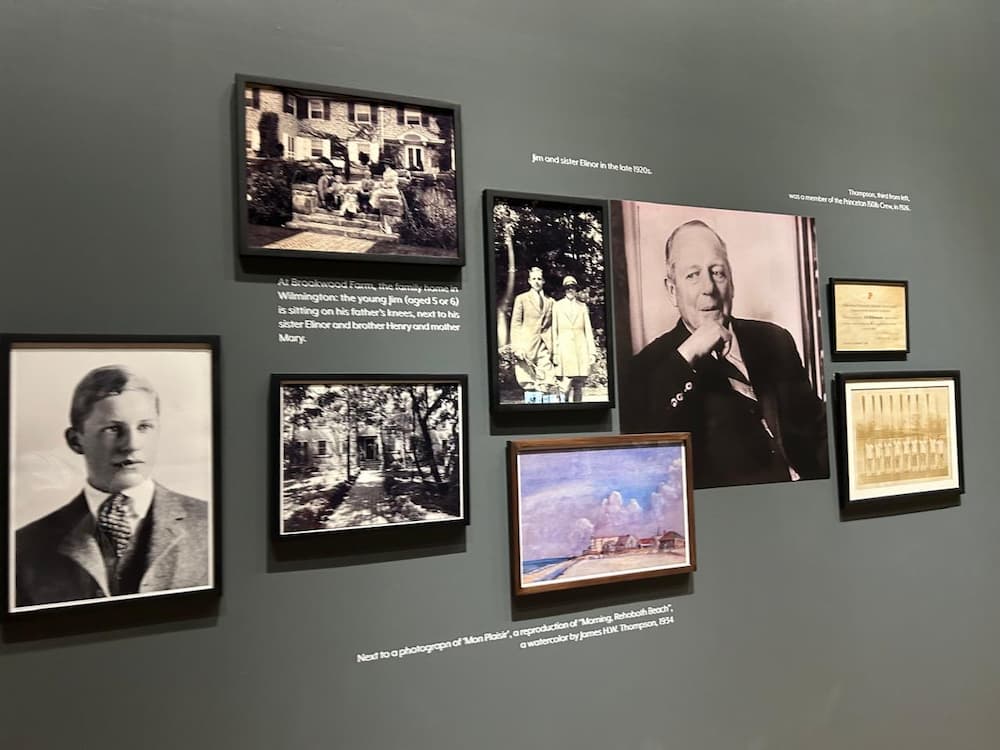
Whenever we recommend the Jim Thompson House to our clients, this is one of the first questions we hear. Jim Thompson was an American businessman that had a great passion for silk as well Southeast Asian art and antiques. His former home was turned into a museum, preserved just as he left it. Now it is one of Bangkok’s most important cultural landmarks.
Born in the United States, Jim Thompson was trained as an architect and later worked as a military intelligence officer during World War II. After the war, he chose to stay in Bangkok and became deeply involved in reviving the Thai silk industry. Alongside this, Thompson began collecting Southeast Asian art and antiques, driven more by the goal of preserving these relics rather than simply having a large personal collection.
In 1967, Jim Thompson disappeared while on holiday in Malaysia’s Cameron Highlands. He was never found, and the mystery surrounding his disappearance remains unsolved.
From a home to a museum
What makes the Jim Thompson House so special is that it was an actual home, it was not built as a museum.
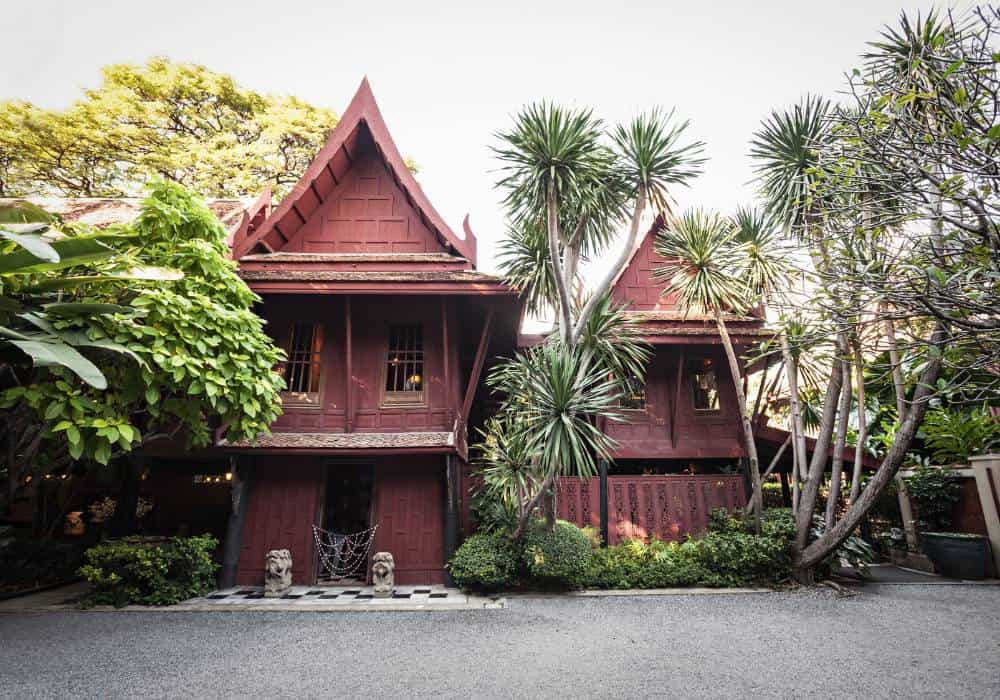
The house itself was originally built as traditional teak houses, and the complex consists of 6 traditional Thai houses. They were brought from Bangkok and Ayutthaya, dismantled, transported by canal, and reassembled on site. What makes this even more impressive is the fact the house is built in an entirely traditional Thai style. This means no nails being used at all to hold it together – instead everything is held up together by wooden beams.
From our experience taking visitors here, this small fact often makes them feel a true sense of awe and appreciation for traditional Thai architecture and craftsmanship. Even if you are not particularly interested in antiques or the Jim Thompson story, we still recommend visiting this museum, since visitors to Thailand usually have very limited chances to see how a traditional Thai house looks from the inside, and the Jim Thompson house offers this great opportunity.
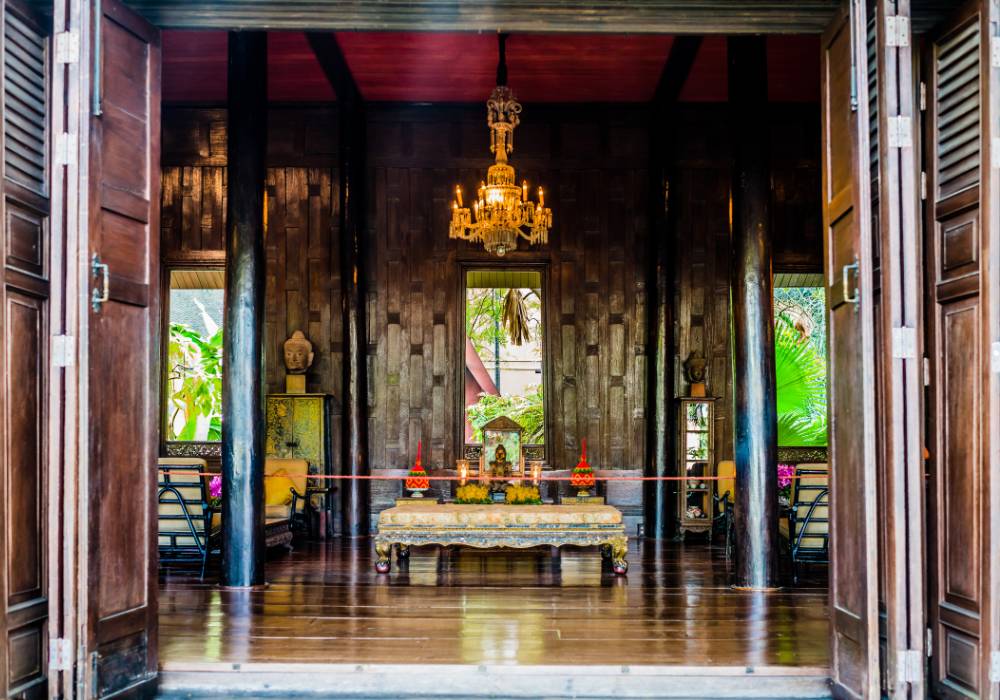
While the house is built using traditional Thai methods, it is not 100% authentic. Jim Thompson also added his personal Western touch. Inside, you can see Italian marble floors and European chandeliers blend seamlessly with Thai design.
At the same time, the house features the classic high door frames often found in Thai houses, believed to prevent evil spirits from entering the house. There is also a spirit house located outside in the garden, this is a small shrine meant to house protective spirits. Almost every traditional Thai home has one, and at Jim Thompson House, it reflects both cultural tradition and the care he took in honoring local beliefs. All of this intertwines an elegant mix of culture and design that is hard for us, and most clients, not to be impressed by.
Art and antiques
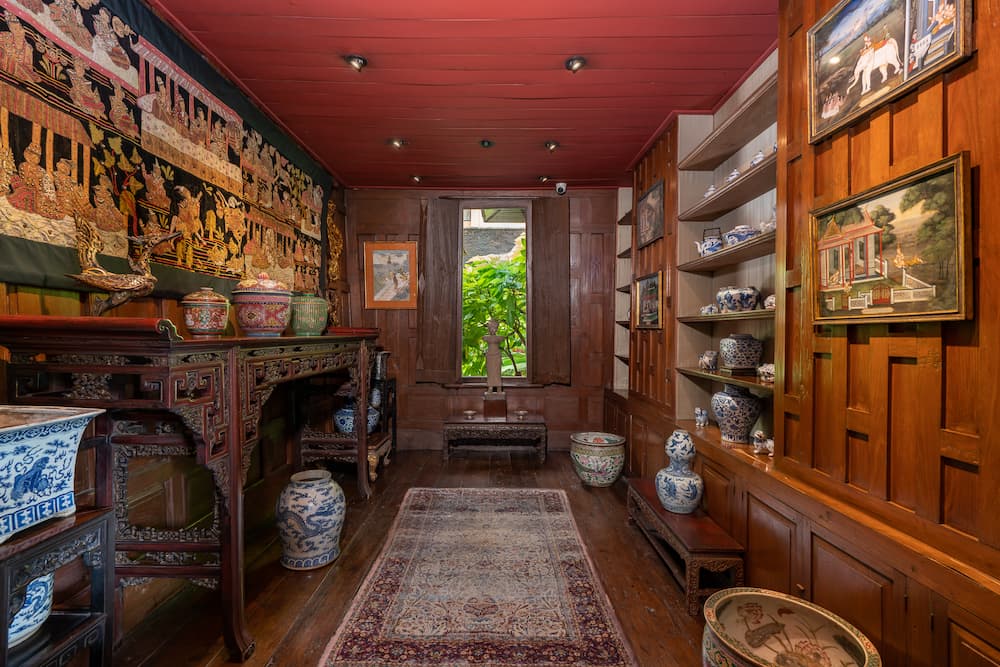
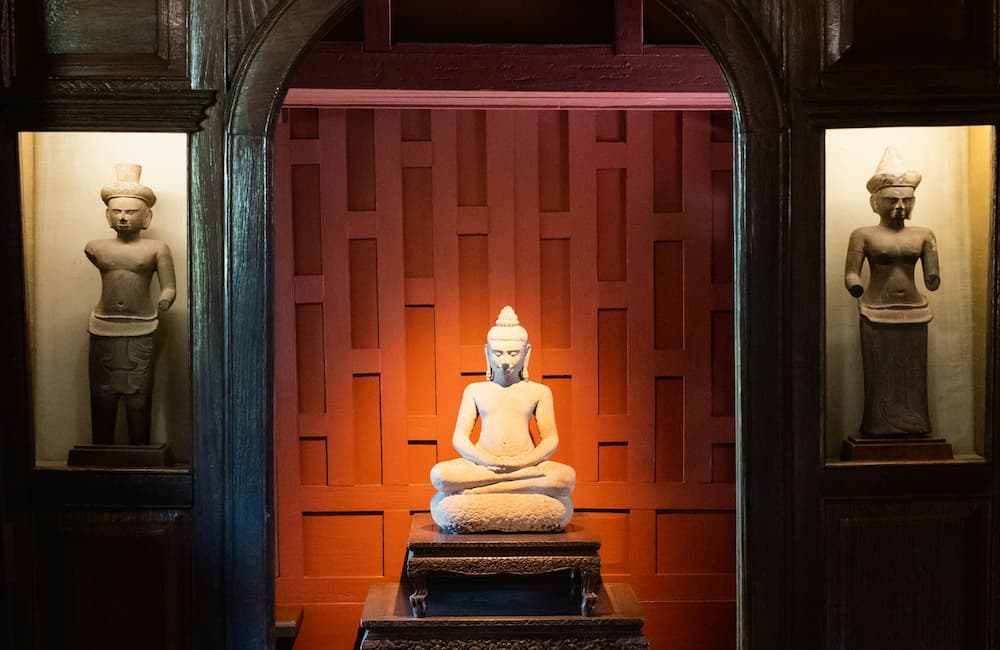
Jim Thompson collected statues, paintings, ceramics, sculptures, rare antiques, and more. His collection includes pieces from Burma, Cambodia, China, and Laos alongside pieces from Thailand. Here, Chinese Ming porcelain, Cambodian relics, rare Thai paintings, and traditional Thai pottery are all scattered yet carefully placed all around the house. Many of these pieces are true antiques, relics from specific moments in history, and their age is clearly visible. One of the most remarkable pieces is found in the garden: a Buddha statue that is over 1,400 years old. We always recommend taking a moment to seek it out, as it quietly stands as one of the most significant and moving highlights of the entire collection.
Attention to detail is important here, and it shows. If you pay close attention, you can see that the design and artwork of the wooden stamps in the garden match the designs of the ceramics right below them. Here, you can see the same traditional koi fish etched in wood and fired into ceramics. Thompson’s love for art and attention to fine detail is shown as a form of art in itself if you pay close attention to your surroundings here.
An urban nature escape
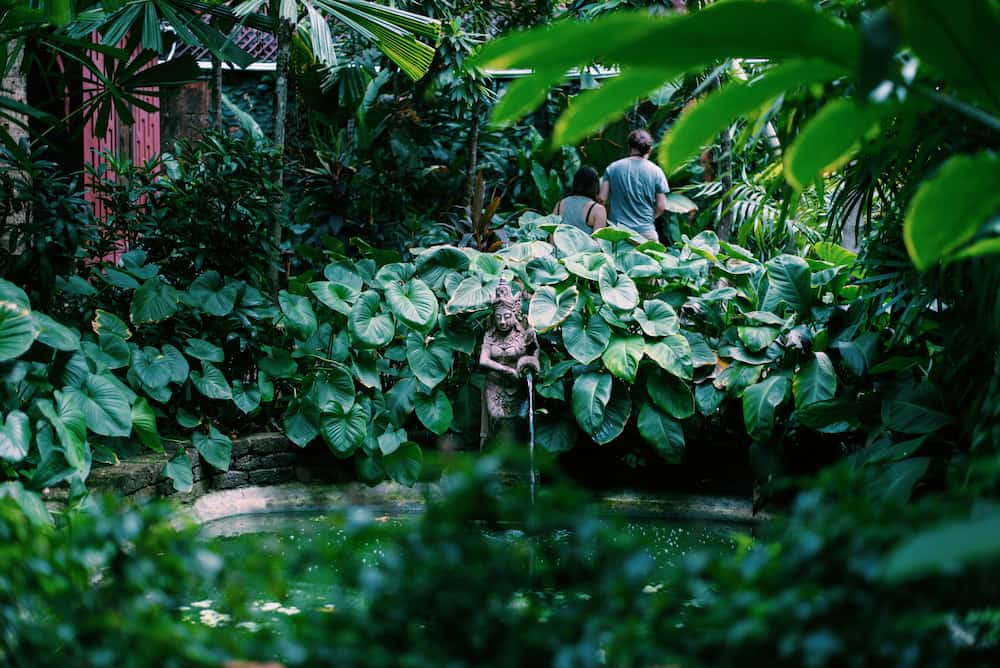
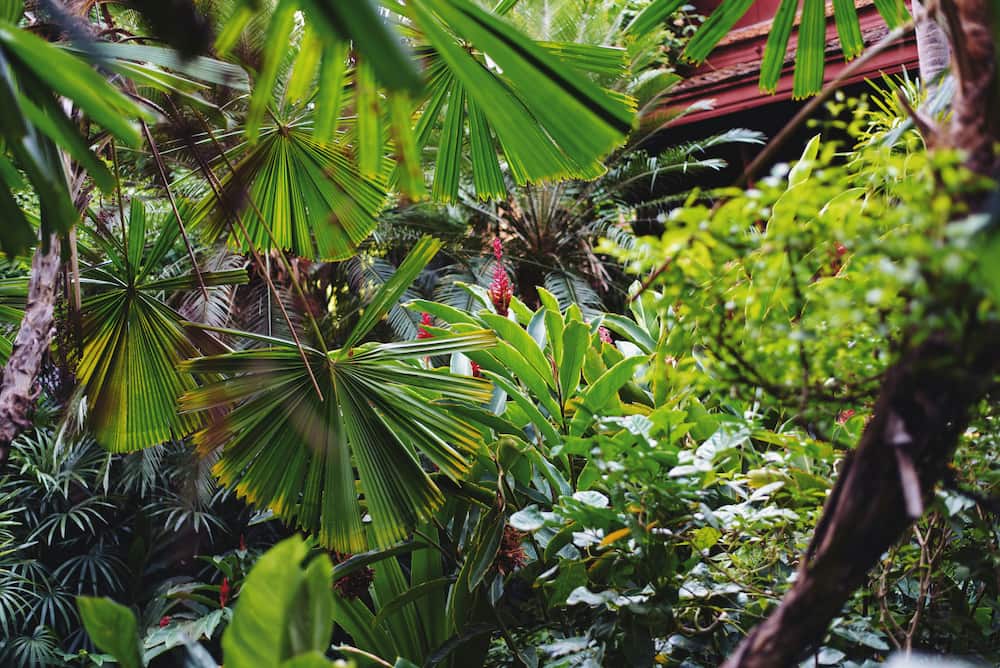
As soon as you walk into Jim Thompson House, you feel as though you have been transported to the middle of the jungle. It is very green and vibrant and full of trees, and there are many green leafy pathways. Here, you are also right by the klong and you can even hear the water crashing against the complex, adding to the overall natural and serene feeling you experience being here. Two things that also really stand out walking around here are the fish (which are everywhere) and the myriad of beautiful tropical flowers all around you. We recommend the garden alone as an escape from Bangkok’s busy and noisy streets, especially if you are looking somewhere nice and calm to escape the afternoon heat.
Taking a break at Jim’s Terrace
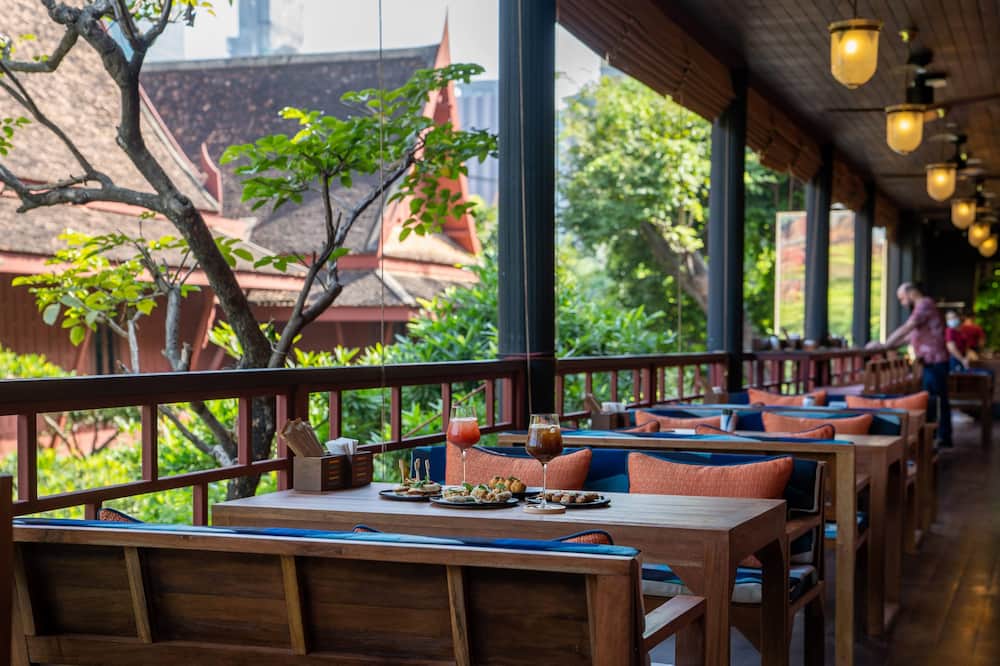
After the tour, we always suggest stopping at Jim’s Terrace. Here you can get a view overlooking the garden, sitting right by the trees. The food is excellent too, an inspired Thai-American fusion. We recommend their Bangkok Burger, which is often highly rated by visitors, and there is also “Thai Tapas” for those who want a quick bite. Their signature honey wines are also quite popular, and the drink selection includes Thai craft beers and local options that pair well with the menu.
Silk, souvenirs, and more art
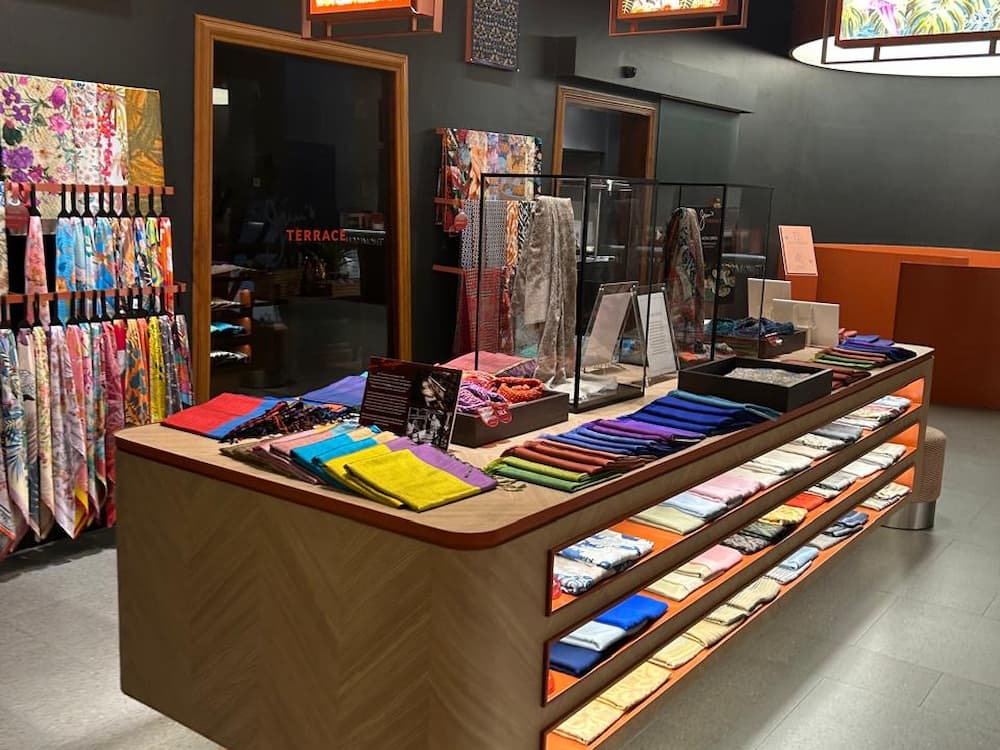
Towards the end of the visit, we usually encourage guests to spend some time at the contemporary art center connected to the house. This area brings a more modern layer to the experience, with rotating exhibitions by local and international artists. There is also a well-curated gift shop and the Jim Thompsom shopping outlet at the exit of the house, giving visitors the chance to shop for beautiful high-quality silk items, home décor, and thoughtfully designed souvenirs inspired by Thai culture.
Our tips:
- We recommend visiting during opening hours at 10AM as it gets very busy and crowded quickly here. Entrance fees are THB 250, both cash and credit/debit card can be used at the ticket counter.
- You will need a guide to access the main house, English tours are available but can be easily booked up, another reason we recommend visiting in the early morning
- This is a traditional Thai house, so you’ll need to remove your shoes before entering
- Photos are allowed indoors, but videos are not
- This location is not wheelchair accessible as there are a lot of steps
What’s nearby? How to combine it into a Bangkok day out
The tour around the Jim Thompson House usually takes around forty-five minutes to an hour. If you are particularly interested in art or art history and would like to go into more depth with your guide then it might take longer. If you choose to visit Jim’s terrace it could take two to three hours. We recommend combining this visit with some nearby attractions for some more Bangkok exploration.
Nearby attractions we recommend include:
- Bangkok Art & Culture Centre (BACC)
- Siam shopping district
- Hidden klongs and local neighborhoods rarely seen by first-time visitors
We also recommend combining your visit with one of our curated experiences exploring Hidden Bangkok, if you are looking to combine your visit with something a bit more off-the-beaten-path.
Other FAQs about Jim Thompson House
What are the opening hours of Jim Thompson House?
Jim Thompson House is typically open daily from 10:00 AM to 5:00 PM, with the last guided tour usually starting around 4:00 PM. We recommend arriving earlier in the day, as later time slots can be busier.
Is Jim Thompson House suitable for children?
Yes. From our experience, children can enjoy the gardens and the unique traditional houses. However, since guided tours involve listening and walking through historic interiors, the experience is generally more engaging for older children.
Is photography allowed inside Jim Thompson House?
Photography is allowed in the outdoor areas and gardens. However, photography inside the traditional house interiors is usually restricted to preserve the antiques and artwork.
From our experience, we often find that guests are pleasantly surprised by how much they enjoy this stop, even those who did not initially consider themselves museum lovers. It offers insight into Thai and Southeast Asian art, architecture, culture, and history, all while offering a serene, calm escape from the busy city streets. For anyone looking to understand Bangkok beyond temples and shopping malls, the Jim Thompson House remains one of our most confidently recommended visit